Lecture 4: Deep Learning in Medical Imaging
In this lecture, we will understand how deep learning analyzes medical images.
The goal is not to learn technical details, but to understand how AI “sees” and interprets images in a clinical context.
By the end of this lecture, you should understand how AI processes medical images, how it detects patterns, and what its limitations are.

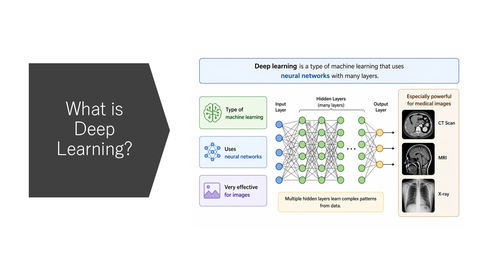
Deep learning is a type of machine learning that uses neural networks with many layers.
It is especially powerful for analyzing images, such as CT scans, MRIs, and X-rays.
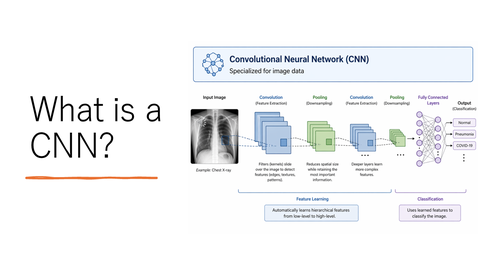
A convolutional neural network, or CNN, is a type of model designed specifically for image analysis.
It processes images by detecting patterns at different levels of complexity.
A computer does not see an image the way we do.
It sees a grid of numbers, where each pixel has a value representing brightness or intensity.
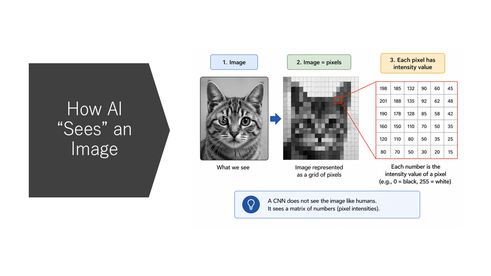
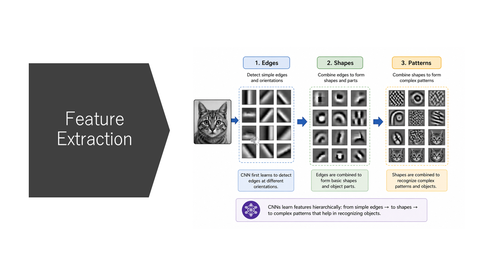
CNNs extract features in stages.
First, they detect simple features such as edges.
Then they combine these into shapes.
Finally, they recognize complex patterns that may correspond to disease.
This is similar to how a radiologist learns.
At first, you learn basic structures.
With experience, you recognize patterns associated with disease.
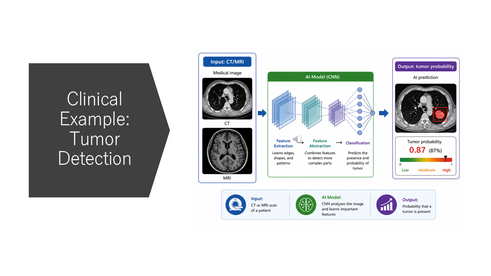
In tumor detection, the model analyzes the image and predicts whether a tumor is present.
It may also highlight suspicious regions.
In breast cancer screening, AI can analyze mammograms and identify areas that may require further evaluation.

Heatmaps highlight which parts of the image influenced the model’s decision.
This helps clinicians understand what the AI is focusing on.

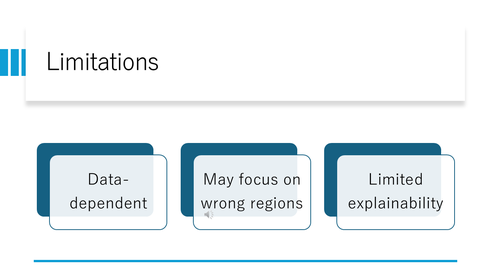
However, AI also has some limitations.
AI models depend heavily on training data and may fail in new clinical settings.
Sometimes, they may focus on irrelevant parts of the image instead of clinically meaningful regions.
Even with heatmaps, full explainability is still limited.
AI should be used as a support tool, not as a replacement for clinical judgment.
Final decisions must always involve the clinician.

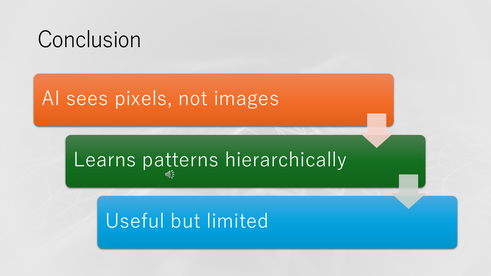
AI analyzes images as numerical data and learns patterns in multiple stages.
It is a powerful tool, but it must be used carefully in clinical practice.