Lecture 1: Introduction to AI in Medicine
Today, we will understand what artificial intelligence is in medicine—not from a technical perspective, but from a clinical perspective.
The goal is not to turn you into engineers, but to help you safely and effectively use AI in patient care.
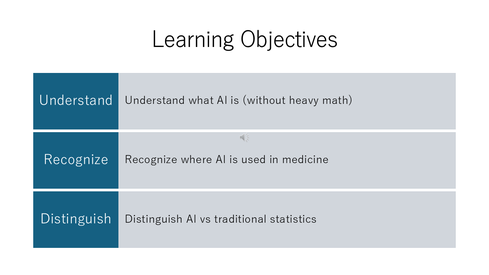
By the end of this lecture, you should be able to understand what AI actually means in clinical practice, where it is already used, and how it differs from traditional statistical methods.
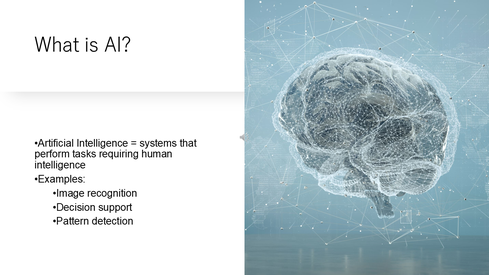
AI refers to computer systems that can perform tasks that normally require human intelligence, such as recognizing patterns, making predictions, or assisting decisions.
In simple terms, machine learning takes input data and produces a prediction.
For example, given a chest X-ray, the model predicts the probability of pneumonia.
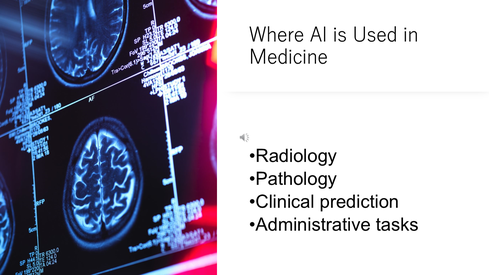
AI is already used in many areas of medicine.
In radiology, it detects abnormalities in images.
In pathology, it analyzes digital slides.
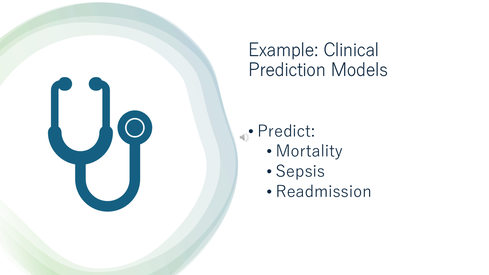
In clinical care, it predicts risks such as mortality or ICU admission.

One of the most successful applications of AI is in radiology.
AI models can analyze images and detect patterns that may indicate disease.
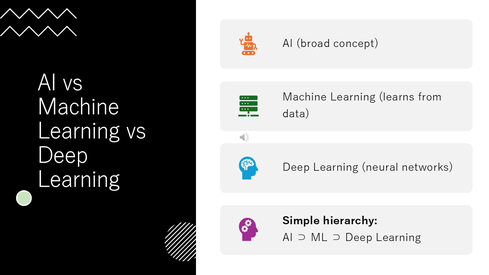
Machine learning is a subset of AI where systems learn from data instead of being explicitly programmed.
Deep learning is a further subset that uses neural networks, especially useful for images and complex data.
In pathology, AI can analyze entire microscope slides and detect cancerous cells, sometimes even highlighting suspicious regions.
AI is also used to predict clinical outcomes, such as which patients are at high risk of deterioration or readmission.
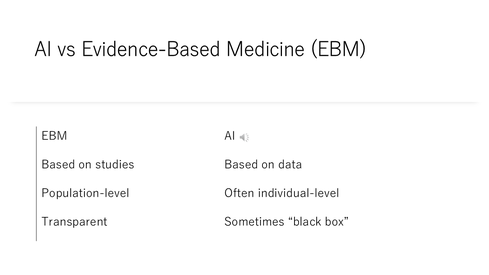
Traditional medicine relies on evidence-based guidelines derived from studies.
AI, on the other hand, learns directly from data and may provide individualized predictions—but often with less transparency.
Let’s take a concrete example.
A convolutional neural network analyzes a chest X-ray and outputs the probability of pneumonia.
It learns patterns from thousands of images.

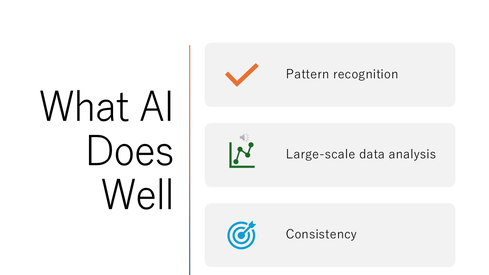
AI is particularly strong at recognizing patterns in large datasets and performing repetitive tasks consistently.
However, AI has important limitations.
It depends heavily on the data it was trained on, and it may fail in new or different clinical settings.
In addition, many AI models have limited explainability.
This means that the system can provide a prediction, but it cannot always clearly explain how or why that prediction was made.
This lack of transparency can make it difficult for clinicians to fully trust the system.

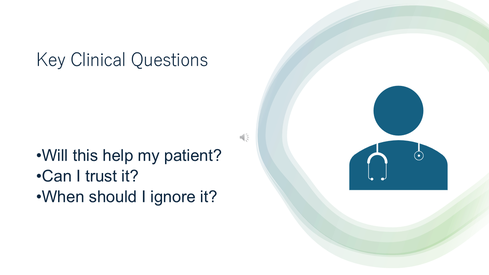
As clinicians, these are the most important questions.
AI is a tool—not a replacement for clinical judgment.
AI is already part of medicine.
Understanding its strengths and limitations is essential for safe patient care.